We studied the presence of plastics on the Camí de Cavalls to identify their distribution and their sources, and thus help guide effective action.
At 40 Nord Outdoor S.L. we have been working for years to make the Camí de Cavalls much more than an itinerary for walking or cycling: we conceive it as a natural and cultural-heritage space that must be understood, respected, and preserved. Precisely for that reason, the presence of waste—and especially plastics—concerns us both because of its environmental impact and because of what it says about our relationship with the territory. In recent years, we have carried out regular outings to collect plastics, and we have also joined the Plastic Free Menorca commitment.
Now, we are presenting a study on the presence of plastic waste that we carried out with guidance from Plastic Free Menorca Alliance. With this study, we wanted to take things a step further: to have our own data, collected on the ground, to help us understand where waste concentrates, what kinds of waste it is, and why it appears in some places and not in others.
The result is not only a snapshot of the situation, but a useful basis for guiding realistic actions: awareness-raising, management, and conservation along the route. And, above all, to focus efforts where the problem really lies.
Study details
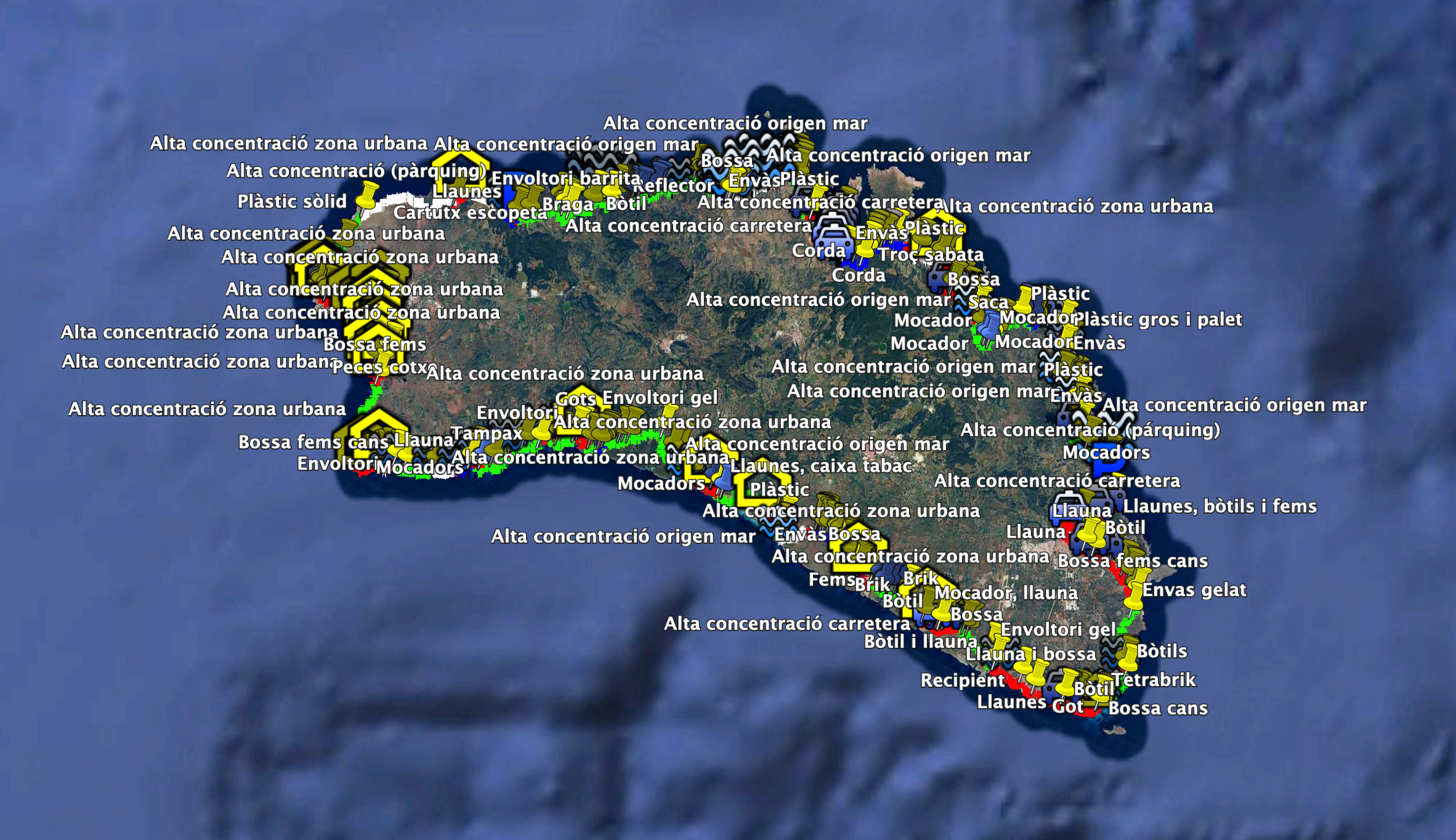
Fieldwork was carried out between July 15 and 31, 2025, with a team of 4 people. It involved walking the 185 kilometers of the Camí de Cavalls and geolocating and photographing every piece of waste that was found. The work was then completed with the digitization, organization, and analysis of the data through January 2026.
To make it manageable, we divided the Camí de Cavalls into:
- 32 sub-sections for the sampling days (planned according to access points and time needed).
- 97 sub-sections for the analysis (defined according to the environment, user type, level of use, and possible sources of waste).
Waste was recorded individually and geolocated with photographs and coordinates. However, in urban areas, on roads, and especially at coastal points with heavy accumulation or microplastics, it was not always possible to record waste presence precisely, both because of the sheer quantity and its typology. In these locations, the study’s data should be interpreted with caution. By contrast, on natural path sections without such high concentrations of waste, recording could be carried out much more rigorously and thoroughly.
What does waste accumulation depend on? Keys: the environment and how it is used
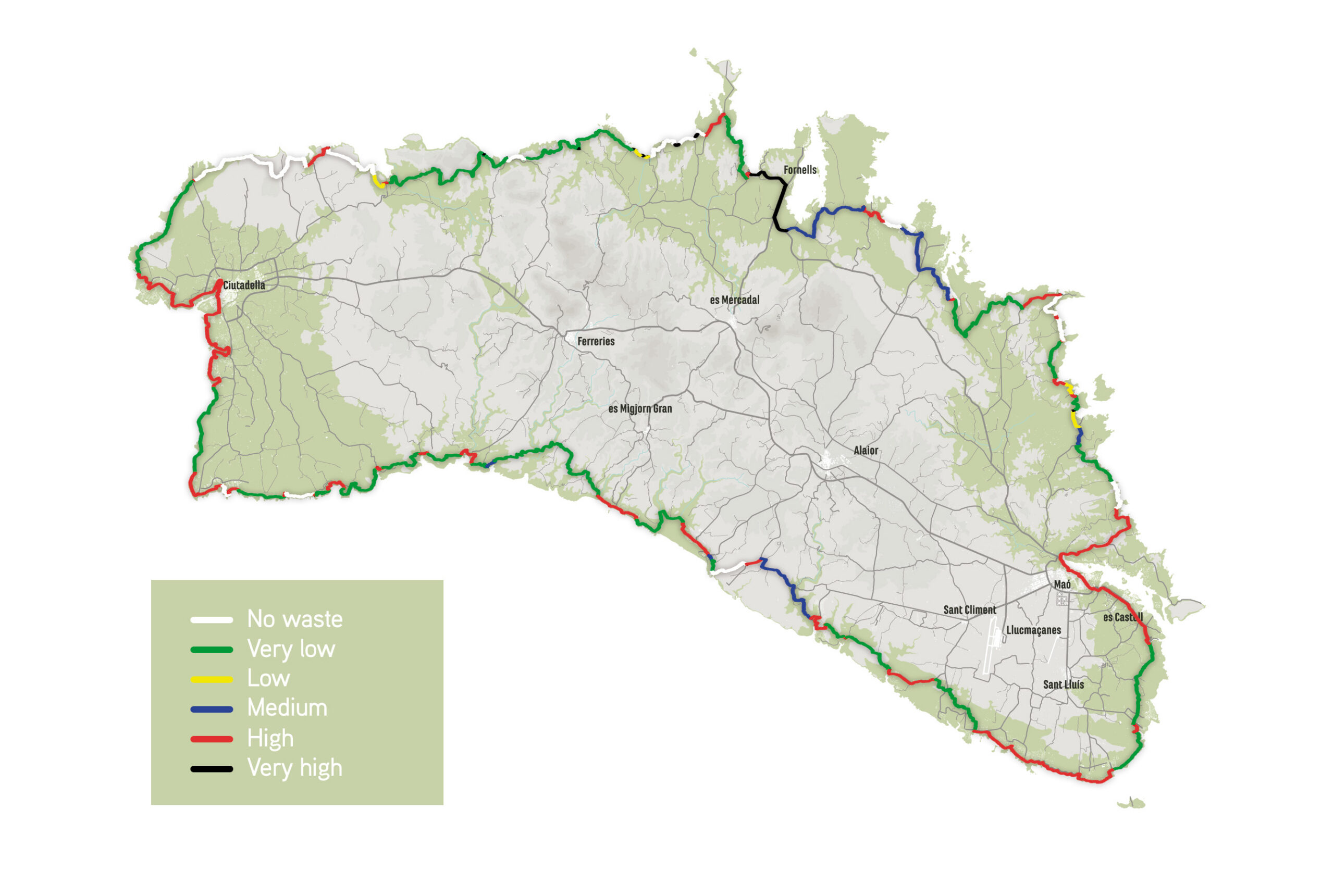
The study shows a very consistent pattern: waste concentration does not depend only on how many people pass through, but above all on what type of environment it is and what type of use occurs there. To understand this, we classified the sections according to waste density:
NO CONCENTRATION: no waste.
- Most frequent users: Hikers/cyclists on route.
- Environment: Forest/scrubland/countryside.
LOW CONCENTRATION: one piece of waste every 997 meters on average.
- Most frequent users: Hikers/cyclists on route.
- Environment: mainly Forest/scrubland/countryside, sometimes near Cove/beach/cliff.
- Source: mostly Path users, and in isolated cases Farming and livestock activities.
MEDIUM CONCENTRATION: one piece of waste every 168 meters on average.
- Most frequent users: Hikers/cyclists on route, Occasional walkers and Beach users.
- Environment: mainly Forest/scrubland/countryside.
- Source: Path users and Farming and livestock activities.
HIGH CONCENTRATION: one piece of waste every 40 meters on average.
- Most frequent users: Street and road users and Beach users.
- Environment: Urban area and Cove/beach/cliff.
- Source: Cars and street users or the Sea.
VERY HIGH CONCENTRATION: less than 10 meters on average between pieces of waste.
- Most frequent users: Hikers/cyclists on route and Beach users.
- Environment: Cove/beach/cliff.
- Source: the Sea.
Looking at the route as a whole, a significant part of the Camí de Cavalls falls into low or no-concentration categories, but there are also points where waste levels spike. And this leads us to one of the most important conclusions: a relatively small proportion of the route accounts for a disproportionately large share of the problem.
Where do plastics accumulate the most?
The main accumulation areas identified by the study are:
- Coastal spots (small coves, cliffs, and points where waste carried by the sea ends up).
- Parking areas and access points.
- Road sections.
- Urban areas.
- Heavily visited beaches.
In these environments, waste almost never comes from the route itself: there are external inputs (marine or urban) and “stay” dynamics (people who stop, eat, picnic, go down to the beach, etc.). Put another way: there are points where the Camí de Cavalls “receives” waste because it is connected to spaces and uses that generate or accumulate it.
The coast: when waste arrives on its own
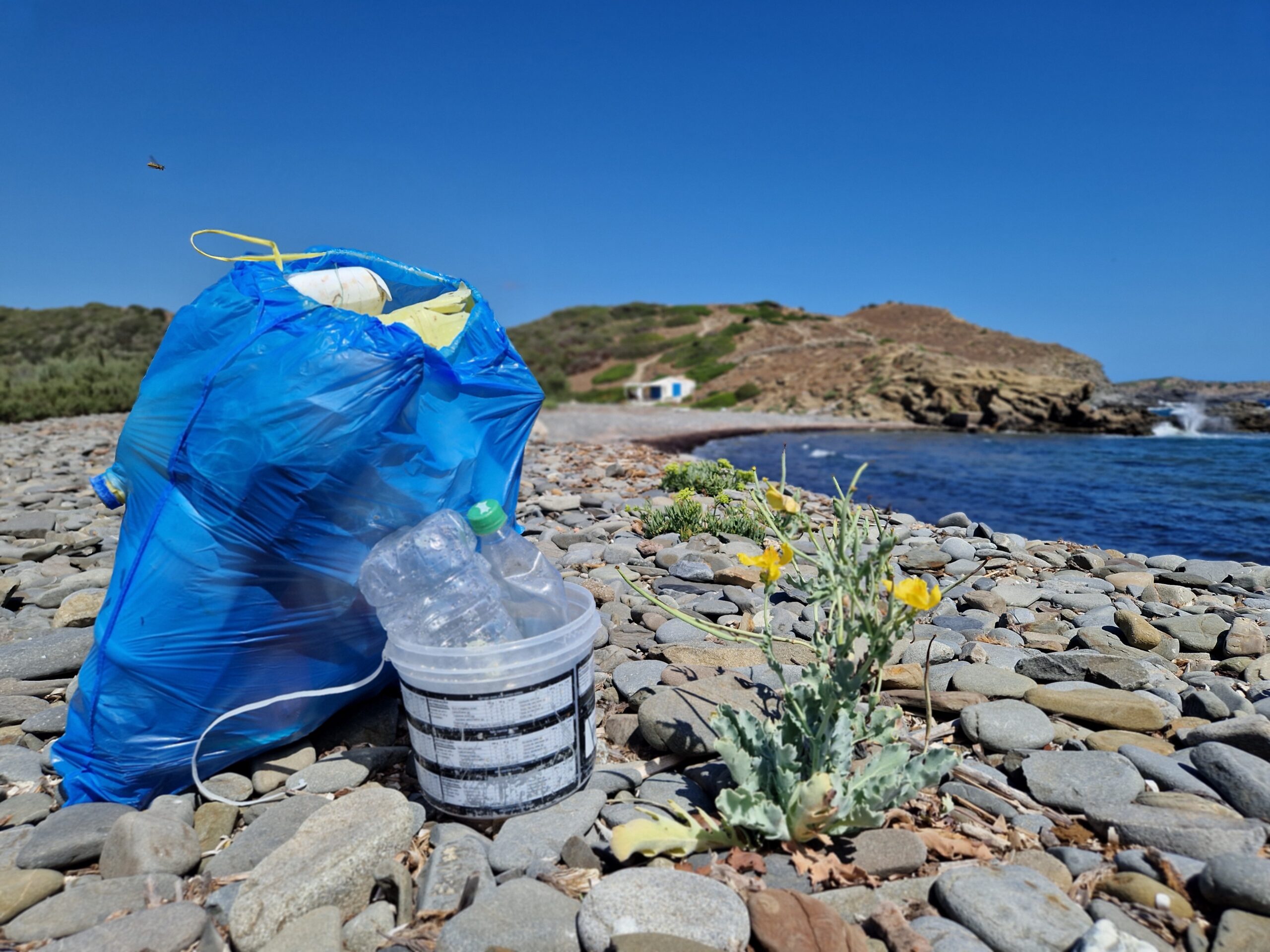
One of the strongest conclusions is that sections with very high concentration are almost always sections dominated by marine dynamics. On the coast, waste can appear even when human traffic is low, because the sea acts as a transporter and accumulator.
And in the more natural areas?
When we think of the Camí de Cavalls, many of us picture the “classic” section: forest, scrubland, and countryside. This type of environment accounts for more than half of the route and, in general, shows no or low concentrations.
The analysis provides a very illustrative estimate: on these non-urban sections that are not beaches/coves, if we attribute 1 meter of impact to each piece of waste, the route would be more than 99.8% free of waste; if the impact is estimated at 5 meters per piece of waste (equivalent to a visual impact), it is still more than 99.1% free of waste. This does not mean there is no litter, but rather that there are no continuous hot spots as on the coast or in urban surroundings—instead, waste is very dispersed and distributed in a fairly random way.
It’s not just “how many people”: it’s “what kind of people” (and what they do)
One of the study’s conclusions is that user type influences the presence of waste more than the intensity of use.
- Hikers and cyclists “on route” are mostly associated with sections with no or low waste, even when use is moderate or high. Direct waste generation attributable to this use is, in general, low and anecdotal.
- Occasional walkers appear more often on medium-concentration sections, especially in transition areas.
- Beach users and street/road users are the ones most associated with high concentrations, especially in coastal and urban environments, where “stay” waste, external inputs, and accumulations that are hard to quantify come together.
What types of waste are most common?
On the typical route sections (hiking/cycling), the waste generated by path users tends to be small plastics (whole wrappers or fragments, small bottles, etc.) and paper napkins, very dispersed and with a fairly random distribution.
However, in these same natural environments another important element appears: waste associated with farming and livestock activity, which tends to be bulkier. And in places with high human presence (such as unserviced natural beaches), toilet paper and tissues stand out in particular, sometimes reaching high concentrations.
Conclusions
If we had to summarize the study’s conclusions in just a few ideas, they would be:
- The environment is the most determining factor: forest/countryside tends to be much cleaner; the coast, urban surroundings, and roads concentrate the problem.
- The use profile is key: “being on route” generates little waste; “stay” uses (beaches) and connections with urban and road sections increase pressure and waste.
- The major black spots have nothing to do with the route itself, but with waste that arrives via the sea, urban dynamics, access points, and parking areas.
- Well-targeted actions can have a real impact, since short distances and very specific points account for a large share of the waste. Directing efforts where the problem is would be the key to achieving a Camí de Cavalls with less waste.
At 40 Nord Outdoor S.L. we promoted this study for precisely this reason: to move from perception to evidence, and from evidence to measures consistent with the future we want for Menorca and the Camí de Cavalls. Now the challenge is to turn these conclusions into shared actions: among organizations, public administrations, the tourism sector, and above all the people who love and travel around the island.
Study on the presence of plastics on the Camí de Cavalls (in Catalan)