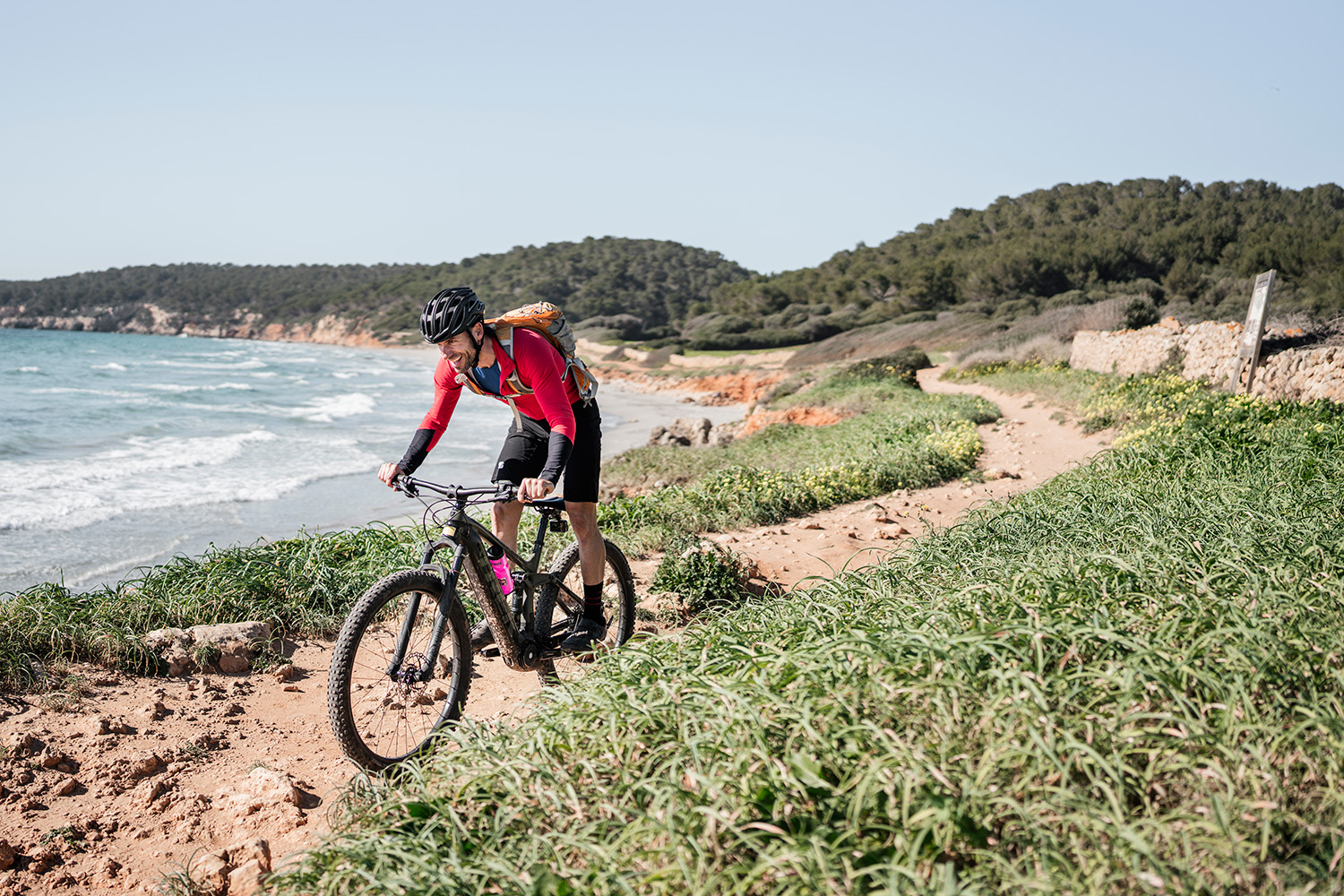
When electric assist helps… and when it doesn’t: keys to choosing the right route and getting the most out of e-MTB in Menorca.
Electric mountain bikes have changed the way we understand MTB. They have made longer routes accessible, opened up elevation gains that once required peak fitness, and allowed for rides with more kilometers and less cardiovascular effort. They have also allowed riders of different fitness levels to pedal together with greater balance. In less than a decade, e-MTB has gone from being a novelty to becoming a common choice for discovering mountain landscapes and stage routes.
That said: an e-bike does not automatically make any route easy. And on Camí de Cavalls 360º, this distinction is especially relevant.
Camí de Cavalls 360º, especially in the Plus and Standard options, contains many rough sections and short yet intense, technical climbs and descents. The key difficulty factor is neither distance nor elevation gain, but the terrain, shaped by rocks and stones that heavily influence pedaling and require reading the ground well and truly handling the bike, not just pedaling. For this reason, when we talk about e-bikes on Camí de Cavalls 360º, the question is not only “will the motor help me?”, but above all: “do I have the technical skills needed to make the most of this help on this terrain?”
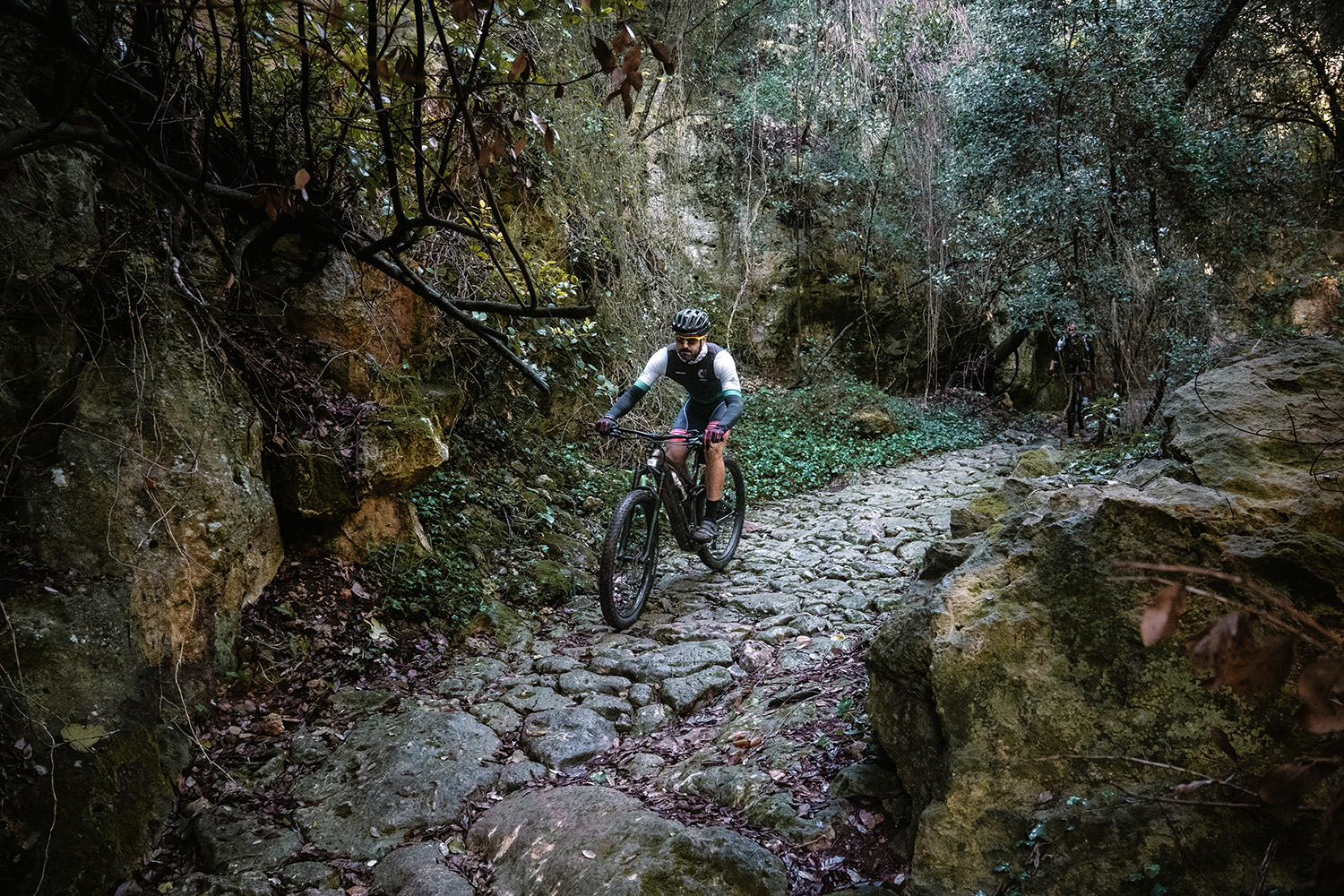
The e-bike: a great physical advantage, but not always a technical one
The great strength of an e-MTB is clear: pedal assist reduces climbing effort and helps maintain intensity throughout the day. On tracks, well-surfaced trails, long climbs, and terrain with good traction, an e-bike can be a magnificent ally for anyone looking to minimize effort. It helps conserve energy, smooth out spikes in exertion, and reach the end of the stage with less fatigue.
It can also provide stability. The extra weight of the motor and battery, usually positioned low on the frame, makes many e-MTBs feel very planted on certain descents or fast, open terrain. For certain riders, this feeling of a bike “glued” to the ground can build confidence.
Yet this same weight is also one of its drawbacks when the terrain gets tough. An e-MTB is harder to move in tight spaces, more difficult to reposition in sharp corners, penalizes you more when clearing a rock step at low speed, and demands more body work and greater control when the trail turns rough. On a technical climb, the motor is not enough: you need to choose the line carefully, distribute your weight properly at all times, modulate power to avoid losing traction, and have enough skill to lift or unweight the bike at the right moment.
This is what often catches riders by surprise when coming from a more recreational e-bike background. On easy terrain, assistance can compensate for physical shortcomings. On technical terrain, however, it can expose handling deficiencies. If the rider hasn’t mastered body positioning, braking, line selection, low-speed balance, and traction management, the motor won’t solve the problem. Sometimes, it even accentuates it: too much assist on a rocky slope can spin out the rear wheel; an abrupt start can throw you off balance; and a heavy bike is far more awkward to push or carry when you have to put a foot down.
That is why, on a route like Camí de Cavalls 360º, an e-bike can be a great help or a poor decision. It depends far less on the motor’s power than on the rider’s actual skill level. In many cases, an e-bike can create a false sense of security.
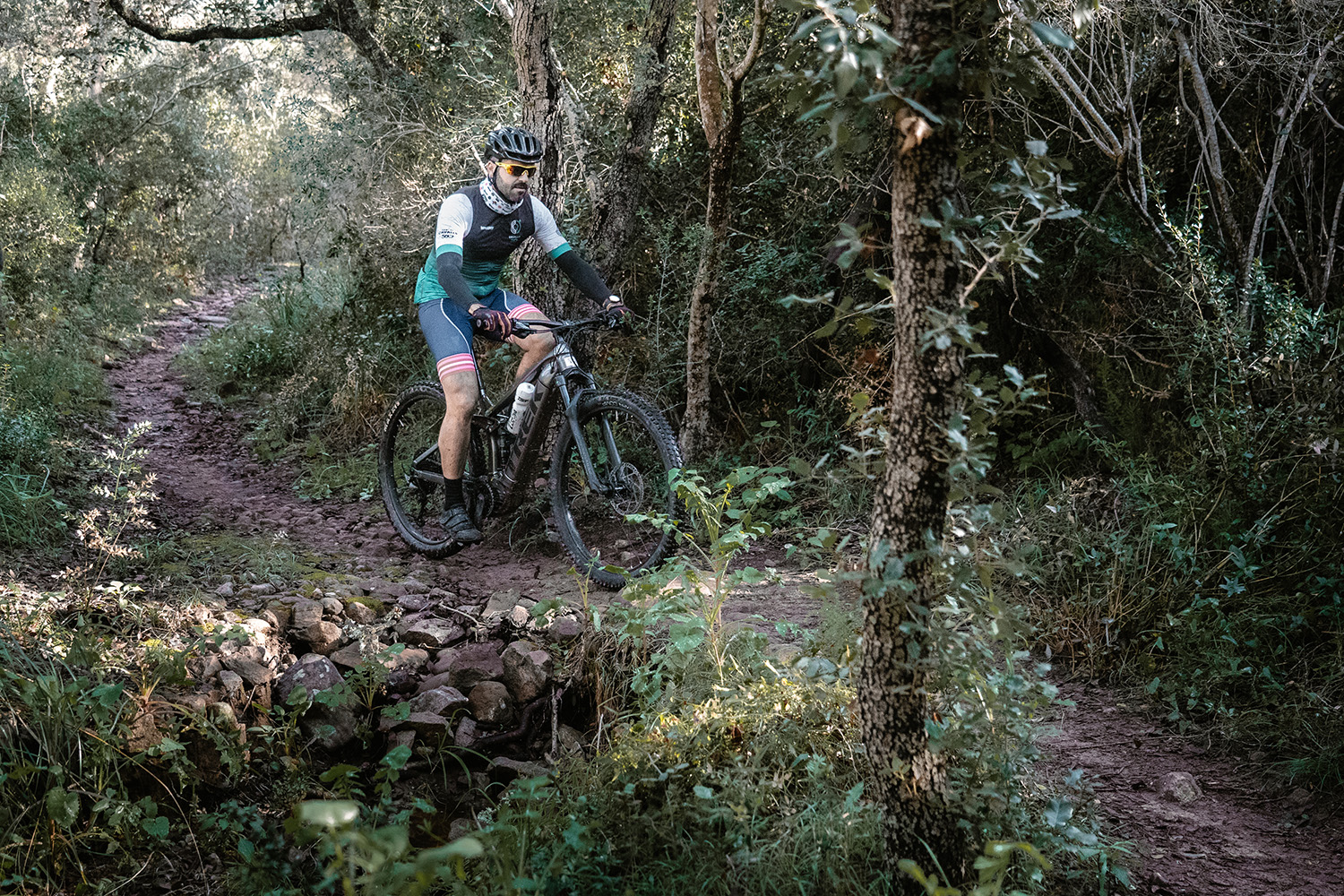
MTB route options in Menorca
40 Nord Outdoor offers different ways to experience Menorca on an MTB, tailoring the route to the participants’ technical and physical level. This tailoring is key, because difficulty in Menorca cannot be measured solely by distance and elevation gain. The characteristics of the terrain mean that two routes with similar stats can have completely different difficulty levels.
These are the MTB route options offered by 40 Nord Outdoor, ranked from most to least technically demanding, along with the suitability of each for e-bikes:
1. Camí de Cavalls 360º Plus
It is the option most faithful to the Camí de Cavalls trail and, therefore, the most authentic and also the most demanding. It is designed for highly experienced riders with an advanced technical level and a clear MTB mindset. Here you will find the most spectacular sections, but also the toughest. We could fill pages and pages, but its difficulty can probably only be understood by those who have ridden it.
The Plus is not a route to “do on an e-bike so it will be easier.” In fact, on many sections the opposite happens. Without very advanced technique, the e-bike adds mass and inertia precisely where agility is needed most. And when it’s time to put a foot down, push, or carry the bike (a situation that, depending on each rider’s technical level and experience, may occur more or less frequently on certain stretches of the Plus), the extra weight becomes an obvious problem. On the Plus, an e-bike is only truly an advantage for very well-rounded riders who are experienced on demanding terrain.
2. Camí de Cavalls 360º Standard
This is the intermediate option. It retains a very significant part of the Camí de Cavalls essence, but avoids many of the most complicated sections, though not all. It remains a demanding MTB route, with rough singletrack and full of moments requiring various technical skills.
For an e-bike, the Standard can make sense in the hands of an advanced rider accustomed to rocky, rough terrain, technical climbs, and handling a heavy bike in slow sections. It is not the right option for those simply looking for a comfortable route with electric assist.
3. Camí de Cavalls 360º Basic
The Basic is designed to reduce technical difficulty compared to the Standard, taking advantage of more sensible alternatives where available. It is an interesting option for intermediate riders who want to experience Camí de Cavalls 360º without tackling some of the most demanding sections.
With an e-bike, the Basic is the first truly recommendable option within the Camí de Cavalls 360º family for riders with some MTB experience who don’t want to face a relentless series of difficult obstacles. Still, “Basic” shouldn’t be confused with “easy”: it is still Menorca, it is still MTB, and there are still plenty of sections that demand focus and skill.
4. Menorca 360º
Menorca 360º is a different proposition: a cycling route to discover the interior of the island, with a much more accessible technical level than Camí de Cavalls 360º. It combines rural roads, tracks, quiet paved sections, and some easy stretches of Camí de Cavalls. It is a very complete way to discover Menorca by pedal, passing through agricultural landscapes, wooded areas, ancient paths, and Talayotic heritage sites.
For the majority of e-bike riders, Menorca 360º is the most sensible option. It lets you take advantage of electric assistance (greater physical range, more comfort, and more margin to enjoy the surroundings) without turning the ride into a succession of sections where you have to push or manage an overly heavy bike on highly technical singletrack.
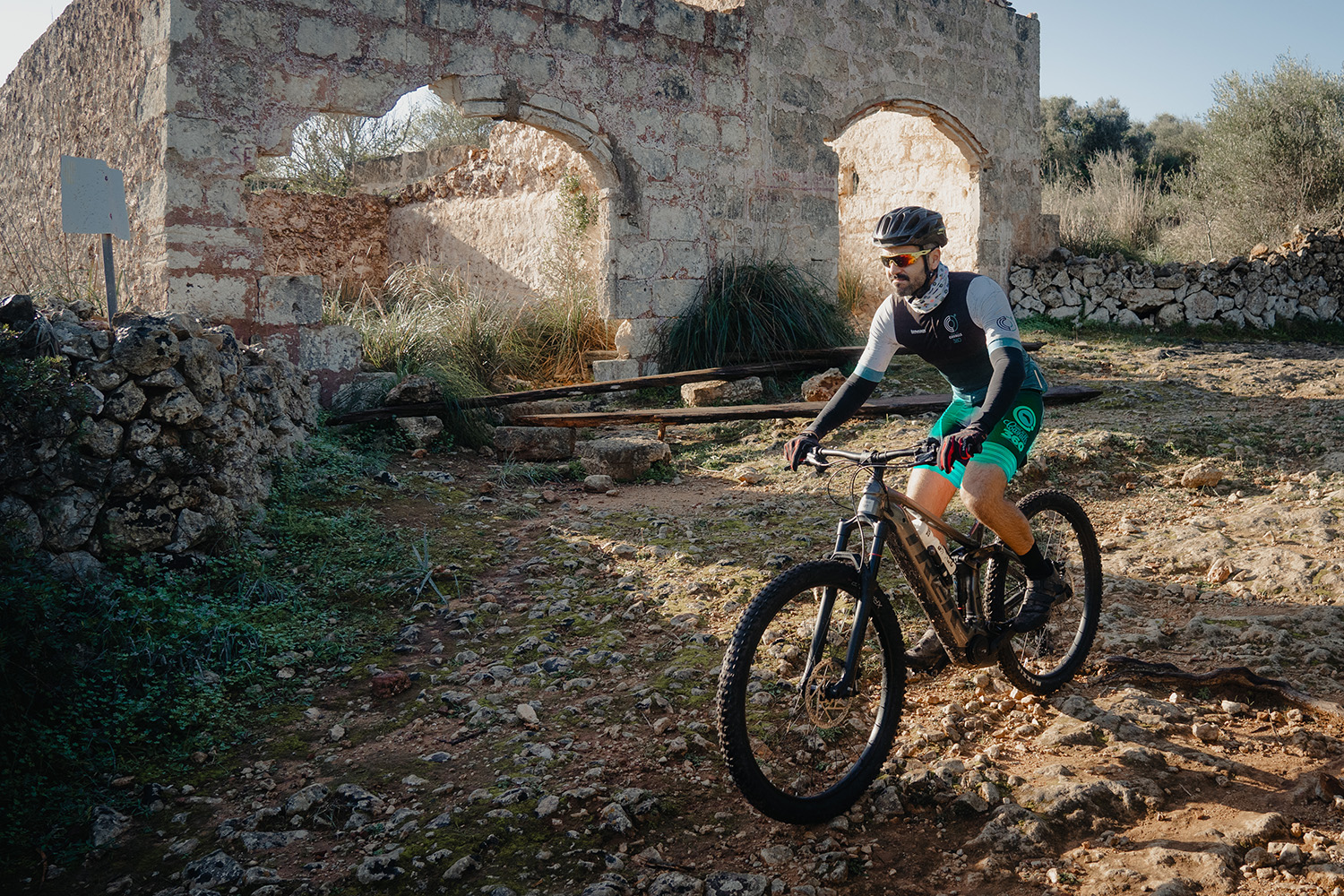
Which route to choose with an e-bike?
The decision should start with an honest self-assessment. Not of the type of bike you have, but of your true skill level on technical terrain.
Camí de Cavalls 360º Plus is for experts only. It makes sense with an e-bike if you are a rider with very advanced technical skills, accustomed to technical trails, rock, slow passages, difficult climbs, and demanding descents.
Camí de Cavalls 360º Standard is for riders with advanced skills and proven experience. It can work with an e-bike if you have already mastered technical MTB and want to reduce the physical load without giving up an intense route.
Camí de Cavalls 360º Basic is the most suitable option within Camí de Cavalls 360º for riders with intermediate skills. It allows you to experience part of the essence of the trail, but with a more reasonable selection of sections.
Menorca 360º is the best recommendation for most e-bike users. It is especially suitable for those who want to discover Menorca by cycling, enjoy the scenery, take advantage of electric assistance, and minimize situations of having to push or carry the bike. It is also the most sensible option for groups with varying levels.
Conclusion: the key is choosing the right route
An e-MTB has its own characteristics, offering a distinct experience. Used properly, it allows you to cover more kilometers, manage effort better, and enjoy rides that would be much more demanding on a conventional bike. But on Camí de Cavalls 360º, and especially on the Plus version, electric assist does not eliminate the main difficulty: the terrain.
Menorca doesn’t have huge elevation gains, but the terrain is full of details that make it very demanding. The challenge isn’t just climbing vertical meters; it’s clearing rocks, maintaining traction, reading the trail, descending under control, adapting to constant changes in ground surface, and knowing when to pedal and when to put a foot down. In this context, an e-bike can be a huge help to someone who already has sufficient technique. But it can make life very difficult for someone who expects the motor to do the work for them.
Therefore, the best decision is to choose the route with good judgment. Plus for experts. Standard for advanced riders. Basic for intermediate levels eager for Camí de Cavalls. And Menorca 360º for the majority of e-bike users who want to discover the island smoothly, enjoy the journey, and head home feeling they made the right choice.
In the end, that is the key: it’s not about proving anything on the trail, but about choosing well to truly enjoy it.